 totaladmin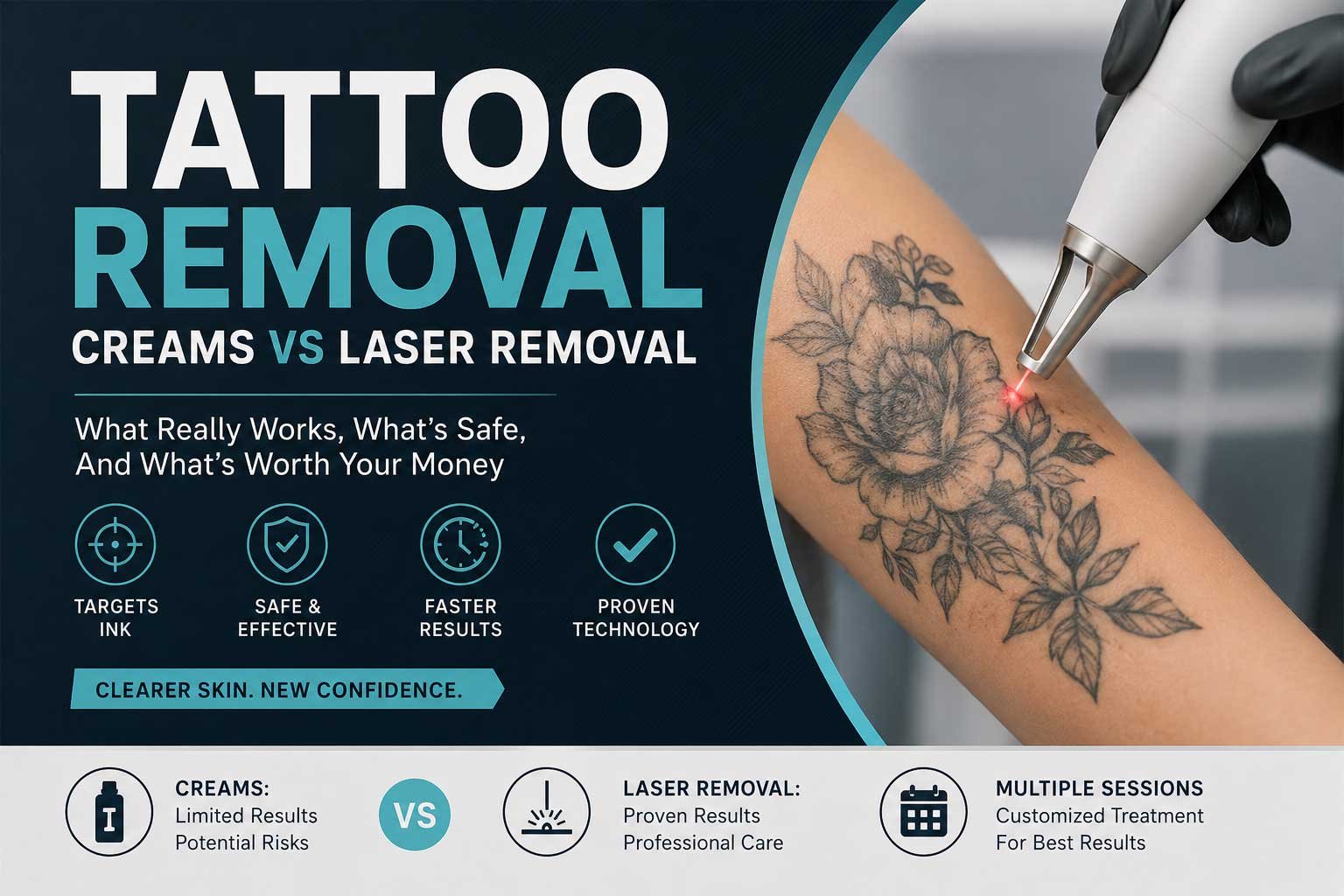
Getting a tattoo can feel exciting at the time, but years later, your feelings about that ink may change. Whether it reminds you of a past relationship, has faded unevenly, no longer matches your personal style, or simply didn’t turn out the way you hoped, wanting to remove or lighten a tattoo is more common than you might think.
One of the first questions people often ask when exploring their options is: Can tattoo removal creams work instead of laser removal?
The short answer is that tattoo removal creams rarely produce meaningful tattoo removal, while professional laser treatment offers a more established and effective approach for significant fading or removal.
In this guide, we’ll take a closer look at tattoo removal creams vs laser removal, including how each method works, effectiveness, safety, discomfort, healing time, costs, and potential side effects. We’ll also explore laser fading for cover-ups and what you can realistically expect from treatment.
If you’re considering tattoo removal in Madison, Wisconsin, or the surrounding area, this guide will help you better understand your options before spending time and money on products or treatments that may not deliver the results you’re hoping for.
Why Tattoos Are Difficult to Remove
Tattoo ink is specifically designed to remain in the skin for years, which is exactly what makes unwanted tattoos so difficult to remove.
When a tattoo artist creates a tattoo, needles deposit pigment beneath the outermost layer of the skin and into the dermis. Unlike the epidermis, which continually sheds and renews itself, the dermis is a deeper and more stable layer of skin. This allows tattoo pigment to remain visible long after the tattoo has healed.
Your immune system recognizes tattoo ink as foreign material and gradually attempts to clear it away. However, many ink particles are too large for the body to remove efficiently. Over time, some smaller particles may be carried away, which helps explain why tattoos can naturally fade or lose some of their sharpness as they age. Still, most of the pigment remains trapped within the skin.
This is why topical tattoo removal creams and ordinary exfoliation cannot simply erase a tattoo. These products mainly affect the skin’s surface and generally cannot reach the ink particles embedded deeper in the dermis.
Professional laser tattoo removal takes a different approach. Instead of peeling or damaging the surface of the skin, laser energy targets the tattoo pigment itself.
We will explain the full laser removal process in more detail below.
What Are Tattoo Removal Creams?
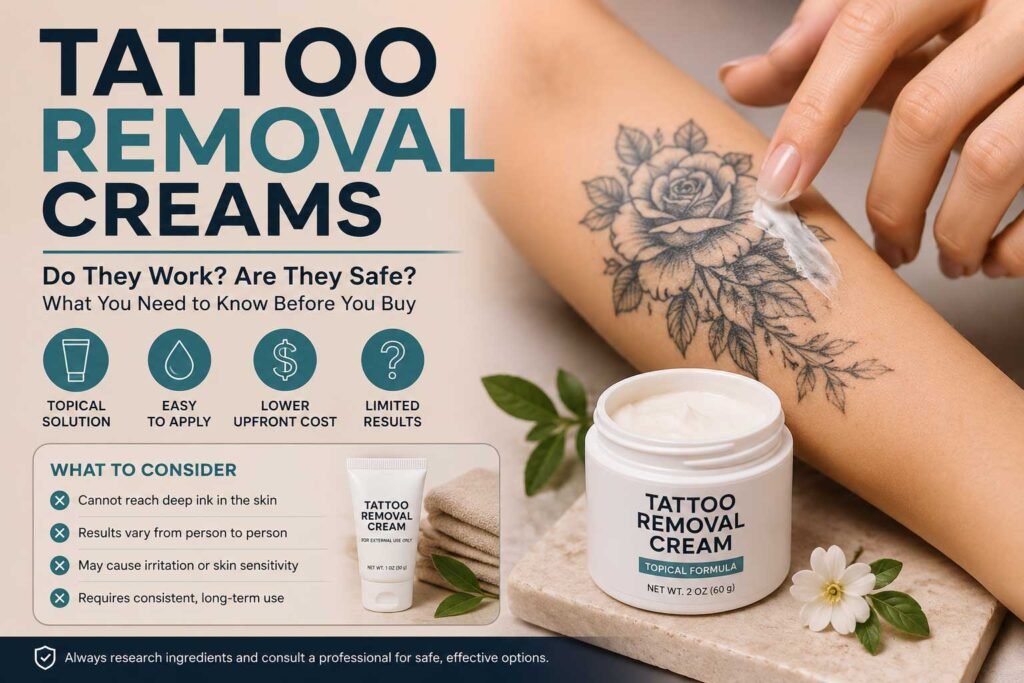
Tattoo removal creams are topical products marketed as a convenient, inexpensive, and pain-free alternative to professional laser tattoo removal. They are typically sold online or over the counter and claim to gradually fade unwanted tattoos when applied regularly over a period of weeks or months.
Depending on the product, tattoo removal creams may claim to:
- Fade or lighten tattoo pigment
- Reduce the appearance of dark ink
- Exfoliate or peel away upper layers of skin
- Brighten the skin around a tattoo
- Make unwanted tattoos less noticeable over time
- Provide a “laser-free” or at-home tattoo removal solution
Many of these products are advertised using terms such as “natural tattoo removal,” “chemical fading,” or “tattoo removal without laser.” However, these marketing claims can be misleading because tattoo ink is located within the dermis, a deeper layer of skin that topical creams generally cannot effectively reach.
Ingredients vary widely between products. Some tattoo removal creams and fading treatments may contain substances such as glycolic acid, retinoids, kojic acid, hydroquinone, trichloroacetic acid (TCA), bleaching agents, or other exfoliating acids. These ingredients may affect the surface of the skin or alter pigmentation, but that does not mean they can safely remove tattoo ink embedded within the dermis.
Do Tattoo Removal Creams Actually Work?
In most cases, tattoo removal creams do not completely remove tattoos and may provide little to no noticeable fading. The main reason is straightforward: tattoo ink is deposited within the dermis, while topical creams primarily work on or near the surface of the skin.
The epidermis, or outermost layer of skin, naturally renews itself over time. However, tattoo pigment sits deeper in the more stable dermal layer, which is why a tattoo does not simply disappear as surface skin cells are shed and replaced. A cream applied to the skin cannot easily reach and break apart these deeply embedded ink particles.
Some people may report subtle changes in the appearance of a tattoo after using fading creams for an extended period. Results, when they occur, can vary depending on factors such as the tattoo’s age, ink color, depth, density, and the specific ingredients in the product. An older or already faded tattoo, for example, may appear to lighten slightly, while dense professional tattoos and tattoos containing multiple colors are generally much more difficult to affect with topical products.
It is also important to distinguish between lightening the skin around or over a tattoo and actually removing tattoo ink. Certain ingredients may exfoliate the skin or alter surface pigmentation, temporarily making a tattoo appear less prominent without eliminating the pigment itself.
Products that attempt to create more dramatic results through strong acids, bleaching agents, or aggressive chemical exfoliation may also increase the risk of irritation, chemical burns, discoloration, and scarring.
For anyone seeking substantial fading, preparation for a cover-up, or the greatest possible degree of removal, creams are unlikely to provide the desired result. Professional treatment is generally a more realistic option.
The Biggest Problems With Tattoo Removal Creams
Tattoo removal creams can sound appealing because they promise a simple, inexpensive way to fade unwanted ink from the comfort of home. However, there are several important limitations and risks to consider before applying these products to your skin.
1. Results Are Usually Very Limited
The biggest problem with tattoo removal creams is their limited effectiveness. Even after weeks or months of use, many people see little noticeable change.
Some people spend weeks or even months repeatedly applying creams without seeing meaningful improvement. When visible fading does occur, results may be:
- Uneven or patchy
- Extremely gradual
- Limited to slight lightening
- Inconsistent across different ink colors
- Incomplete even after prolonged use
An older, naturally faded tattoo may appear to change slightly, but dense professional ink, deeply placed pigment, and multicolored tattoos are particularly unlikely to respond significantly to topical creams.
For someone hoping for complete tattoo removal or substantial fading for a future cover-up, these limitations can make creams a disappointing and potentially costly experiment.
2. Skin Irritation Can Be Severe
Another major concern is the potential for skin irritation and injury. Some tattoo fading products contain strong acids, bleaching agents, exfoliating ingredients, or other chemicals intended to peel or lighten the skin.
Depending on the ingredients, concentration, frequency of application, and individual skin sensitivity, possible side effects may include:
- Burning or stinging
- Redness and inflammation
- Blistering
- Chemical burns
- Hyperpigmentation or hypopigmentation
- Uneven skin discoloration
- Changes in skin texture
- Permanent scarring
Trying to remove a tattoo by aggressively damaging or peeling away layers of skin can cause lasting cosmetic changes without actually eliminating the deeper tattoo pigment. In some cases, the resulting scar or discoloration may become more noticeable than the original tattoo.
3. No FDA-Approved Tattoo Removal Cream Exists
One important fact consumers should know is that the FDA has not approved tattoo removal creams or do-it-yourself tattoo removal kits as safe and effective methods for removing tattoos.
This is an important distinction because marketing terms such as “natural tattoo removal,” “laser-free removal,” or “professional-strength fading” can create the impression that a product has been medically validated when that may not be the case.
The FDA has also warned consumers about tattoo removal products marketed online because they may contain potentially harmful ingredients and can cause skin reactions, burns, or scarring.
Before applying any strong acid, bleaching agent, or chemical peel to tattooed skin, it is important to understand that damaging the surface of the skin is not the same as safely removing tattoo ink from the dermis. For substantial tattoo fading or removal, professional laser treatment offers a more targeted approach designed specifically to break down embedded pigment while minimizing unnecessary damage to the surrounding skin.
What Is Laser Tattoo Removal?
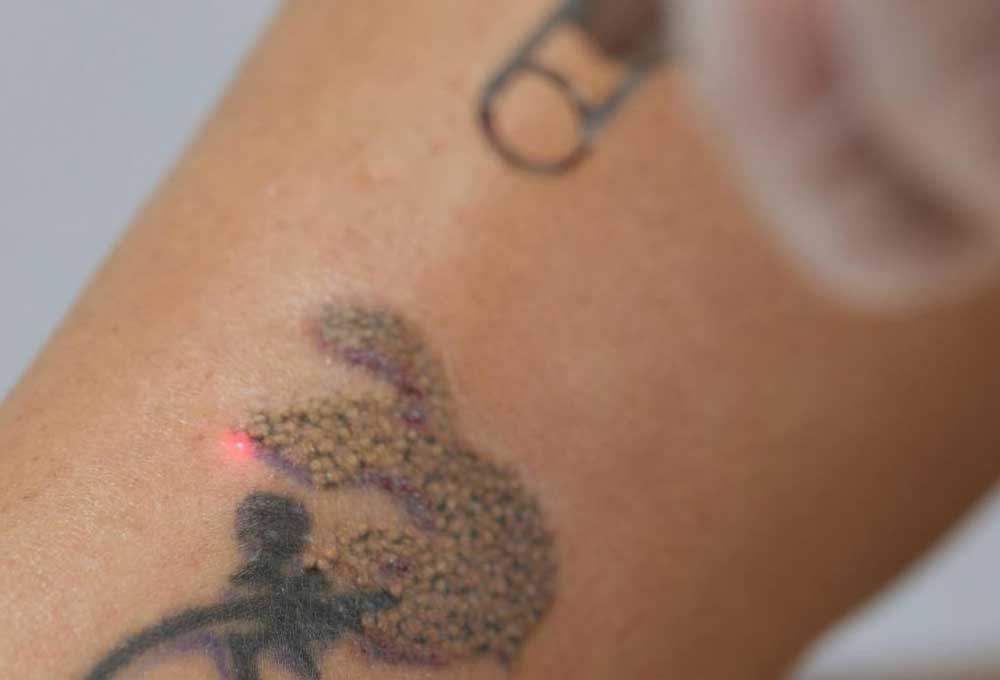
Laser tattoo removal is a professional treatment designed to fade or remove unwanted tattoo pigment using concentrated pulses of light energy.
Modern clinics may use picosecond lasers, Q-switched lasers, or multi-wavelength systems depending on the tattoo colors, skin characteristics, and treatment goals.
Unlike topical products, laser technology can target pigment beneath the skin’s surface. The next section explains exactly what happens during and after treatment.
Different tattoo colors absorb different wavelengths of light, which is why the type of laser and wavelengths available can influence treatment results. Black and other dark pigments generally respond well because they absorb a broad range of laser wavelengths, while colors such as green, blue, red, yellow, and certain pastel shades may require specific wavelengths or additional treatment sessions.
One of the biggest advantages of professional laser tattoo removal is that treatment can be adapted to different tattoo colors and characteristics. The goal is to achieve progressive fading while minimizing unnecessary damage to the surrounding skin.
Because tattoos vary considerably in size, color, ink density, depth, age, location, and application technique, results are different for every person. Most tattoos require a series of treatments spaced several weeks apart to allow the skin to heal and give the body time to clear fragmented ink particles between sessions.
How Laser Tattoo Removal Works
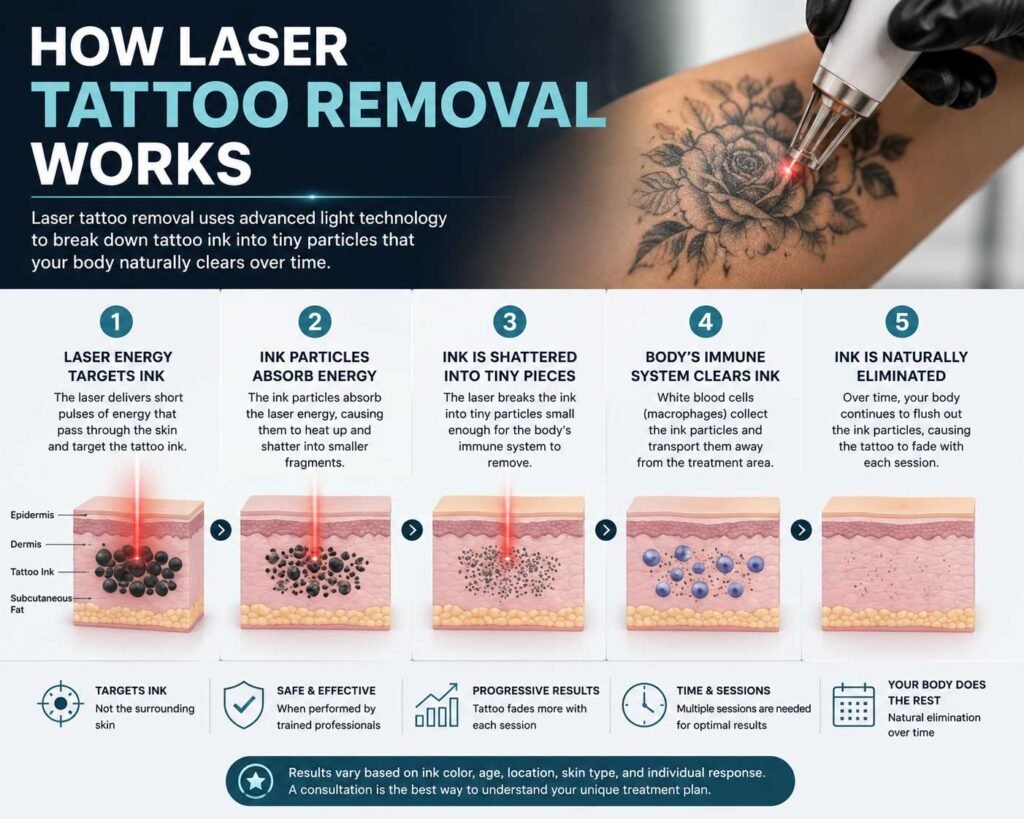
Laser tattoo removal works by delivering rapid, highly concentrated pulses of light energy directly into the tattoo pigment beneath the skin. The tattoo ink absorbs this energy, causing larger pigment particles to break apart into much smaller fragments without physically cutting or removing the skin.
Once the ink has been fragmented, the body’s natural immune and lymphatic processes gradually help clear away some of these smaller particles. This process does not happen overnight. The tattoo typically continues to fade during the weeks following each treatment, which is one reason laser tattoo removal sessions are spaced apart to allow time for healing and ink clearance.
Different Wavelengths Target Different Ink Colors
Tattoo ink colors absorb light differently, so no single laser wavelength is equally effective for every pigment. Modern tattoo removal systems may use multiple wavelengths to target a broader range of colors.
In general:
- Black ink typically responds best because it absorbs a broad spectrum of light wavelengths.
- Dark blue and green inks can often be treated successfully but may require specific wavelengths depending on the exact pigment.
- Red and orange inks may respond well when treated with an appropriate wavelength.
- Yellow, white, pastel, and fluorescent inks can be more challenging and may require additional treatments or respond unpredictably.
The age, depth, density, and chemical composition of the tattoo ink can also influence how successfully a particular color responds to treatment.
What Happens After Each Laser Treatment?
The fading process continues long after the laser session itself. In simplified terms, three important things happen:
- The laser targets and fragments tattoo pigment. Short pulses of energy break larger ink particles into smaller pieces.
- The body gradually processes the fragmented ink. Immune cells and the lymphatic system help clear some of the smaller pigment particles over the following weeks.
- The tattoo progressively becomes lighter. With each successful treatment and healing cycle, more pigment may be broken down and cleared, causing the tattoo to gradually fade.
Because the body needs time to heal and process fragmented ink, tattoo removal is gradual rather than instant. Most tattoos require multiple sessions, and results vary depending on the tattoo and individual response.
Why Laser Removal Is Considered the Gold Standard
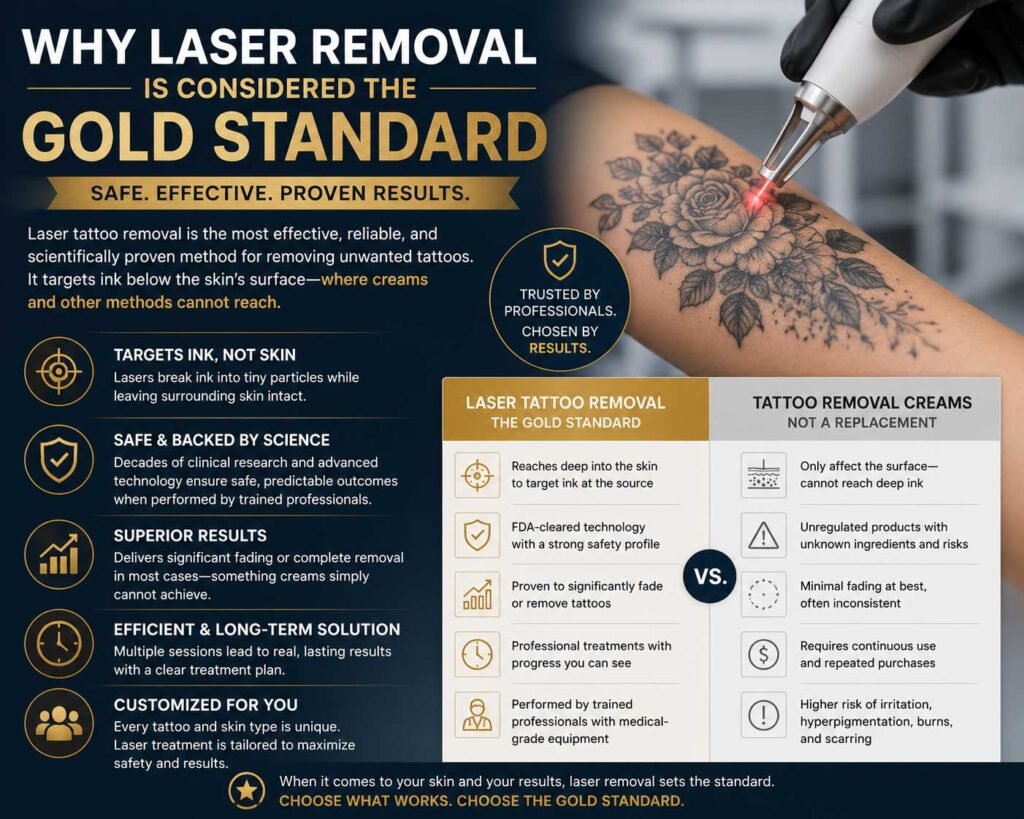
Laser tattoo removal is widely considered the leading professional approach for significant tattoo fading and removal. It offers a level of precision, customization, and control that topical creams and aggressive at-home methods cannot provide.
Some of the key advantages of laser tattoo removal include:
- Designed specifically for professional tattoo fading and removal.
- Can produce significant fading and, in some cases, near-complete removal.
- Works on both professional and amateur tattoos, although the number of treatments required may vary.
- Can target multiple ink colors when appropriate laser wavelengths are available.
- Allows for selective or partial tattoo removal, such as removing one section of a larger design.
- Can lighten tattoos before a cover-up, giving tattoo artists greater flexibility when creating a new design.
- Provides progressive, measurable results over a series of professionally administered treatments.
Every tattoo is different. A small, faded black tattoo may respond very differently from a new, heavily saturated, multicolored cover-up. That’s why a personalized treatment plan matters—the laser settings and overall approach should reflect the tattoo itself, the person’s skin, and how the area responds from one session to the next. Professional laser treatment allows these factors to be evaluated and the treatment approach adjusted accordingly.
For people considering laser tattoo removal in Madison, Wisconsin, Total Body Laser Med Spa offers professional tattoo removal treatments using advanced laser technology. Whether the goal is significant fading, complete removal, or simply lightening an existing tattoo before a cover-up, a personalized consultation can help establish realistic expectations and determine an appropriate treatment plan.
While no tattoo removal method can guarantee identical results for every person, professional laser technology offers a level of precision, depth, and effectiveness that topical tattoo removal creams and potentially damaging DIY methods cannot match.
Ready to Fade Your Tattoo?
Save 50% Today.
Stop spending money on creams that can’t reach tattoo ink beneath the skin. Discover professional laser tattoo removal with a personalized treatment plan designed around your tattoo and your goals.
- Advanced Laser Technology
- Personalized Treatment Plans
- Professional Care
- Madison, Wisconsin
Tattoo Removal Creams vs Laser Removal Comparison
When comparing tattoo removal creams vs laser tattoo removal, the biggest difference is how each method interacts with tattoo pigment. Topical creams primarily affect the skin’s surface, while professional laser technology is designed to target ink particles embedded deeper within the dermis.
| Feature | Tattoo Removal Creams | Laser Tattoo Removal |
|---|---|---|
| Overall Effectiveness | Generally limited | High potential for significant fading |
| Complete Removal | Extremely unlikely | May be possible for some tattoos, although results vary |
| Targets Deep Tattoo Ink | Generally no | Yes |
| FDA Status | No FDA-approved creams or DIY kits for tattoo removal | FDA-cleared laser devices are available for tattoo removal |
| Treatment Speed | May require prolonged use with little noticeable change | Progressive fading over a series of treatment sessions |
| Risk of Skin Damage | Harsh ingredients may cause irritation, burns, discoloration, or scarring | Risks exist but may be reduced when treatment is properly performed by a trained professional |
| Upfront Cost | Usually lower | Usually higher per treatment |
| Long-Term Value | Often limited due to minimal results | Generally better for meaningful tattoo fading or removal |
| Best Suited For | Not considered a reliable method for removing embedded tattoo pigment | Significant fading, removal, partial removal, and cover-up preparation |
| Professional Acceptance | Generally not considered an established tattoo removal method | Widely considered the standard professional approach |
For meaningful fading, partial removal, or cover-up preparation, professional laser treatment generally offers greater potential than topical creams.
Results vary depending on the tattoo and individual response, so a consultation is the best way to establish realistic expectations.
Which Tattoos Respond Best to Laser Removal?
Not every tattoo responds to laser treatment in the same way. Some tattoos begin showing noticeable fading relatively quickly, while others require more sessions because of their color, ink density, depth, age, or location on the body.
In general, tattoos that tend to respond more favorably to laser removal include:
Black Ink Tattoos
Black ink is typically the easiest tattoo color to target because it absorbs a broad spectrum of laser light. Many black and dark-colored tattoos respond well to appropriate laser wavelengths, although the total number of sessions still depends on ink density, depth, and other individual factors.
Older and Naturally Faded Tattoos
Older tattoos have often already experienced some natural fading as the body gradually processes small amounts of pigment over time. Because less dense ink may remain compared with a newer tattoo, older tattoos can sometimes respond more readily to laser treatment.
Amateur Tattoos
Amateur tattoos are often applied with less ink and at a shallower or less consistent depth than professionally applied tattoos. As a result, some amateur tattoos may require fewer treatments to achieve significant fading.
However, application technique varies considerably, so an amateur tattoo is not automatically easier to remove in every case.
Smaller Tattoos
A smaller tattoo does not necessarily mean the ink itself will break down faster, but the treatment area is more limited and individual sessions may be shorter. If the tattoo also contains fewer colors and less dense pigment, it may be a good candidate for successful fading.
Tattoos With Less Dense Ink
Fine-line tattoos, lightly shaded designs, and tattoos with lower pigment density may respond more quickly than heavily saturated designs. Dense tribal tattoos, solid blackwork, and heavily layered professional tattoos generally contain more pigment for the laser and body to process.
What Factors Affect Laser Tattoo Removal Results?
Several factors can influence how quickly and effectively a tattoo fades, including:
- Ink color: Black and certain dark pigments often respond more readily, while some lighter, fluorescent, pastel, or specialty inks may be more challenging.
- Ink depth and density: Deeply embedded or heavily saturated pigment may require additional treatments.
- Tattoo age: Older tattoos may already have experienced natural fading and can sometimes respond more favorably.
- Tattoo location: Areas with stronger circulation may sometimes clear fragmented ink more efficiently than areas farther from the heart.
- Skin characteristics: Skin tone and individual pigmentation can influence laser settings and the treatment approach used.
- Immune system response: Because the body plays an important role in processing fragmented ink particles, individual biological response can affect the rate of fading.
- Sun exposure: Tanned or recently sun-exposed skin can increase treatment risks and may require sessions to be postponed until the skin returns to its normal tone.
- Previous cover-up work: Tattoos containing multiple layers of ink can be more complex and may require additional sessions.
An in-person consultation can provide a more realistic estimate based on the tattoo and how the skin responds.
Which Tattoos Are Harder to Remove?

While modern laser technology can significantly fade many tattoos, some designs are more challenging to treat and may require additional sessions, specialized laser wavelengths, or more realistic expectations about the final result.
Certain colors, specialty pigments, dense ink, and multiple tattoo layers can make treatment more complex.
Bright and Multicolored Tattoos
Tattoos containing several bright colors can be more challenging because different pigments absorb different wavelengths of laser light. While black ink absorbs a broad range of wavelengths, colors such as green, blue, red, orange, and purple may require specific wavelengths for effective treatment.
Yellow, pastel, and certain specialty pigments can be particularly difficult to target because they may absorb less laser energy.
Cover-Up Tattoos
Cover-up tattoos often contain multiple layers of pigment, with newer ink placed over an existing design. This increased ink density means there is more pigment for the laser to break down and for the body to gradually process.
In some cases, as the newer tattoo fades, portions of the original tattoo underneath may become more visible before further treatments continue to lighten both layers.
Dense Professional Tattoos
Professionally applied tattoos often contain a greater concentration of ink placed consistently within the dermis. Solid blackwork, tribal designs, heavily saturated lettering, and other dense tattoos may therefore require more sessions than lightly shaded or fine-line designs.
White and Flesh-Toned Ink
White, flesh-toned, and certain cosmetic pigments can be unpredictable during laser treatment. Some contain compounds that may temporarily darken when exposed to laser energy through a process known as paradoxical darkening.
Because of this possibility, a provider may recommend a small test spot before treating a larger area containing these pigments.
Fluorescent and Specialty Inks
Fluorescent, glow-in-the-dark, UV-reactive, and other specialty tattoo inks can be difficult to remove because their exact chemical composition may vary considerably. Some pigments may not absorb available laser wavelengths effectively, making treatment results less predictable.
Large, Multi-Layered Tattoos
Large tattoos do not necessarily resist laser energy more than smaller ones, but they contain more total pigment and may need to be divided into separate treatment areas. Tattoos that have been repeatedly touched up, reworked, or covered with additional designs can be especially complex because of their multiple layers and increased ink density.
Newer Tattoos
New tattoos may also be more challenging than older, naturally faded designs because the pigment has not yet undergone years of gradual breakdown. Laser treatment should only begin after a tattoo has fully healed, and the appropriate waiting period should be determined by a qualified provider.
Even tattoos considered difficult to remove may achieve substantial fading with modern laser systems and an appropriate treatment plan. However, no provider should guarantee complete removal, as results vary based on the tattoo, the individual, the laser technology used, and the body’s response to treatment.
A professional consultation can help determine how challenging a tattoo may be to treat and what degree of fading may be realistic.
Does Laser Tattoo Removal Hurt?
One of the most common questions people ask before scheduling their first treatment is: Does laser tattoo removal hurt?
The answer is that some discomfort is expected, but the intensity varies considerably from person to person. Many people describe the sensation as similar to a rubber band repeatedly snapping against the skin, quick hot pinpricks, or brief bursts of heat.
The good news is that laser tattoo removal sessions are often relatively quick, especially for smaller tattoos. While getting the original tattoo may have taken hours, treating a small tattoo with a laser may take only a few minutes.
What Does Laser Tattoo Removal Feel Like?
During treatment, the laser delivers extremely rapid pulses of energy to the tattoo pigment. Each pulse may create a brief snapping, stinging, or heated sensation.
Common descriptions include:
- A rubber band snapping against the skin
- Quick, hot pinpricks
- A brief stinging or burning sensation
- Short bursts of heat with each laser pulse
The sensation usually stops when the laser treatment ends, although the area may feel tender, warm, or similar to a mild sunburn afterward.
What Affects the Pain Level?
Several factors can influence how uncomfortable laser tattoo removal feels:
- Tattoo location: Areas with thinner skin, more nerve endings, or less fatty tissue—such as the ankles, ribs, fingers, wrists, or feet—may feel more sensitive.
- Individual pain tolerance: Everyone experiences discomfort differently.
- Tattoo size: Larger tattoos require more laser pulses and longer treatment times.
- Ink density: Heavily saturated tattoos may require more intensive treatment.
- Laser settings and technology: The type of laser, wavelength, and energy settings can influence the treatment experience.
- Treatment session: Sensitivity may vary from one appointment to another as the tattoo progressively fades.
How Is Discomfort Managed During Treatment?
Depending on the clinic, laser technology, and treatment area, several methods may be used to help improve comfort, including:
- Cold air cooling systems that continuously blow chilled air over the skin
- Cooling devices or ice packs before or after treatment
- Topical numbing cream when appropriate
- Short breaks during treatment for larger or more sensitive areas
Cooling is particularly helpful because it can reduce the sensation of heat and help soothe the skin during and immediately after treatment.
Is Tattoo Removal More Painful Than Getting a Tattoo?
There is no universal answer because pain tolerance and tattoo location vary from person to person. Some people find laser removal more intense than getting tattooed, while others find it surprisingly manageable.
The biggest difference is often the treatment time. A tattoo that originally took several hours to create may require only minutes to treat during a laser removal session. For many people, the brief duration makes the discomfort much easier to tolerate.
If you’re concerned about pain, ask your provider what comfort measures are available before beginning treatment. Understanding what to expect and discussing options such as cooling or topical numbing can make the experience feel much more manageable.
How Many Laser Tattoo Removal Sessions Are Needed?
Most tattoos require multiple laser treatment sessions to achieve significant fading or removal. There is no universal number of treatments that works for every tattoo because results depend on the ink, the tattoo itself, the laser technology used, and how each person’s body responds.
As a general estimate, some tattoos may fall within these ranges:
- Small, simple, or lightly applied tattoos: Approximately 4–6 sessions
- Professional black ink tattoos: Often 6–10 sessions or more
- Large, colorful, densely saturated, or multi-layered tattoos: May require 10 or more sessions
These numbers should only be considered general estimates. Some tattoos may respond faster, while others can require significantly more treatments or may not disappear completely.
What Determines the Number of Sessions?
The number of sessions depends mainly on:
- Tattoo size and ink density
- Ink colors
- Tattoo age and depth
- Tattoo location
- Previous cover-ups or touch-ups
- Skin characteristics and individual response
Why Are Laser Tattoo Removal Sessions Spaced Apart?
Laser tattoo removal sessions are commonly spaced approximately 6–8 weeks apart, although some providers may recommend longer intervals depending on the tattoo, skin response, treatment area, and stage of removal.
This waiting period is important for two main reasons. First, the skin needs adequate time to heal after each treatment. Second, the tattoo may continue fading for weeks as the body gradually processes fragmented ink particles.
Scheduling treatments too close together does not necessarily produce faster results and may increase the risk of skin irritation or other complications. Following the treatment schedule recommended by your provider gives the skin time to recover and allows the fading process to continue between sessions.
Can a Provider Predict Exactly How Many Sessions You’ll Need?
No provider can guarantee an exact number of sessions before treatment begins. However, an experienced professional can evaluate factors such as tattoo size, age, colors, location, ink density, skin characteristics, and whether the tattoo has been previously covered or touched up.
This evaluation can provide a more realistic estimate of the expected treatment timeline and help determine whether your goal is complete removal, significant fading, partial removal, or simply lightening the tattoo enough for a successful cover-up.
Can Tattoo Removal Creams Completely Remove Tattoos?
Complete tattoo removal from a topical cream is extremely unlikely.
Some products may slightly lighten the tattoo or change the appearance of the surrounding skin, but this should not be confused with actually removing embedded tattoo pigment.
Creams are especially unlikely to remove:
- Dense professional tattoos
- Deeply applied ink
- Colorful tattoos
- Cover-ups and layered tattoos
Products that rely on strong acids, bleaching agents, or aggressive exfoliation may damage the skin without producing meaningful tattoo removal.
For significant fading, partial removal, or cover-up preparation, professional treatment is the more established option.
Are DIY Tattoo Removal Methods Dangerous?
Yes. Many DIY tattoo removal methods found online can seriously damage the skin without actually removing the tattoo pigment beneath it. Techniques involving harsh chemicals, aggressive abrasion, or attempts to peel away layers of skin may lead to painful injuries and permanent changes in skin texture or pigmentation.
Tattoo ink is embedded within the dermis, which means removing or damaging the outer layers of skin does not necessarily eliminate the pigment. Instead, aggressive at-home methods can injure healthy tissue while leaving much of the tattoo still visible.
Dangerous DIY Tattoo Removal Methods to Avoid
Some of the most concerning at-home methods promoted online include:
- Lemon juice and salt abrasion: Repeatedly rubbing acidic lemon juice and coarse salt into the skin can cause significant irritation, abrasions, inflammation, and increased sensitivity to sunlight.
- Salt scrubbing or salabrasion: Attempting to grind away the skin with salt can create open wounds and increase the risk of infection and permanent scarring.
- Sandpaper or at-home dermabrasion: Physically sanding the skin is extremely dangerous and can cause deep wounds, bleeding, infection, pigment changes, and lasting scars.
- Strong acid peels: Applying concentrated acids without professional supervision can result in chemical burns and permanent skin damage.
- Bleach applications: Household bleach should never be applied to the skin in an attempt to remove a tattoo. It can cause severe irritation, chemical burns, and tissue injury.
- Cutting or scraping the skin: Any attempt to physically cut out or scrape away tattooed skin carries serious risks of bleeding, infection, nerve damage, and permanent scarring.
Potential Risks of At-Home Tattoo Removal
Aggressive DIY tattoo removal methods may cause:
- Chemical or friction burns
- Open wounds
- Bacterial infection
- Severe inflammation and irritation
- Hyperpigmentation or hypopigmentation
- Permanent scarring
- Changes in skin texture
- Prolonged pain and sensitivity
In some cases, the damage caused by an at-home removal attempt can make future professional tattoo removal more complicated. Scar tissue, altered pigmentation, and changes to the skin’s texture may affect how the area responds to subsequent treatment.
Why Professional Treatment Is the Safer Approach
Professional laser tattoo removal uses technology specifically designed to target tattoo pigment beneath the skin rather than attempting to burn, scrape, or peel away healthy tissue. When performed by a properly trained professional using appropriate equipment and treatment settings, laser removal provides a much more controlled and targeted approach to tattoo fading.
While all procedures carry potential risks and results vary between individuals, professional laser treatment avoids the unnecessary trauma associated with aggressive DIY removal methods.
If you want to fade or remove an unwanted tattoo, a more controlled and appropriate approach than experimenting with acids, bleach, salt, sandpaper, or other potentially damaging techniques at home.
Laser Tattoo Removal for Cover-Ups
Not everyone who chooses laser tattoo removal wants their tattoo completely erased. In many cases, the goal is simply to lighten an existing tattoo enough to create a better canvas for a new cover-up design.
Without prior fading, a tattoo artist may need to create a larger, darker, or more heavily saturated design to successfully conceal the original ink. Laser tattoo removal can help reduce the visibility and density of the existing pigment, potentially giving the artist more creative flexibility when designing the cover-up.
Depending on the tattoo and the desired result, people may choose:
- Tattoo lightening: Fading the entire tattoo without attempting complete removal.
- Partial tattoo removal: Targeting only a specific section, symbol, name, line, or element of a larger design.
- Fading for a cover-up: Reducing the density of the original ink so a new tattoo can be placed over it more effectively.
How Laser Fading Can Improve a Cover-Up Tattoo
Lightening an old tattoo before a cover-up may make it easier for an experienced tattoo artist to create:
- Brighter cover-up designs with a wider range of possible colors
- Smaller cover-ups that do not need to extend as far beyond the original tattoo
- More detailed artwork with greater creative flexibility
- Cleaner-looking color application with less interference from dark underlying pigment
- More design options rather than being limited to large, heavily shaded artwork
The amount of fading needed depends on the original tattoo’s size, colors, density, location, and the new design being planned. Some tattoos may need only a few laser sessions before they are light enough for a successful cover-up, while darker, denser, or multi-layered tattoos may require additional treatments.
Do You Need to Completely Remove a Tattoo Before a Cover-Up?
Usually, no. Complete removal is often unnecessary when the ultimate goal is to replace the old tattoo with new artwork. Instead, the objective is to fade the existing pigment enough to give the tattoo artist a better foundation for the new design.
The ideal amount of fading should be discussed with both the laser tattoo removal provider and the tattoo artist whenever possible. A tattoo artist may be able to determine how much of the original design needs to be lightened based on the colors, size, placement, and complexity of the planned cover-up.
This is one reason professional tattoo removal clinics and experienced tattoo artists often work together or refer clients to one another. By combining strategic laser fading with thoughtful cover-up design, clients may have more options and greater flexibility when transforming an unwanted tattoo into something they are excited to wear.
Healing After Laser Tattoo Removal
Healing after laser tattoo removal happens gradually, and the skin’s response can vary depending on the tattoo’s size and location, the laser technology and treatment settings used, individual skin characteristics, and how closely aftercare instructions are followed.
Most people experience temporary redness, swelling, tenderness, or other mild skin reactions after treatment. These responses are part of the healing process and typically improve with time, although recovery can differ from one person to another.
Immediately After Treatment
Right after a laser tattoo removal session, the treated area may look and feel different. Common temporary reactions can include:
- Redness around the tattoo
- Mild to moderate swelling
- Tenderness or sensitivity
- A warm or sunburn-like sensation
- Temporary whitening or “frosting” of the treated tattoo
Frosting is a temporary white appearance that can occur immediately after the laser interacts with the tattoo pigment. It typically fades relatively quickly and should not be confused with the actual long-term fading of the tattoo.
The treated area may also feel warm or slightly sore for several hours following the procedure.
During the First Few Days and First Week
As the skin begins to recover, some people may experience:
- Itching
- Dryness or tightness
- Mild peeling or flaking
- Crusting or scabbing
- Temporary darkening of the tattoo
- Small blisters
Not everyone will experience all of these reactions. Some people have very mild redness and tenderness, while others may develop more noticeable swelling or blistering.
It is important to avoid scratching, picking, peeling, or intentionally breaking any blisters that form. Disturbing the healing skin can increase the risk of infection, pigmentation changes, and scarring.
Long-Term Healing and Tattoo Fading
Although the surface of the skin may appear healed relatively quickly, the tattoo fading process continues beneath the surface for weeks after each session.
The laser breaks larger tattoo ink particles into smaller fragments, and the body’s natural processes gradually help clear some of those fragments over time. As this occurs, the tattoo may continue becoming lighter between treatment sessions.
This is why laser tattoo removal treatments are typically spaced several weeks apart. The skin needs adequate time to recover, and the body needs time to process fragmented pigment before the next session.
Why Proper Aftercare Matters
Following your provider’s specific aftercare instructions is an important part of the laser tattoo removal process. Proper care can help protect the healing skin, reduce unnecessary irritation, and minimize the risk of complications.
General aftercare recommendations may include keeping the area clean, protecting it from sun exposure, avoiding picking at scabs or blisters, and temporarily avoiding activities that could expose healing skin to excessive friction, heat, or potentially contaminated water.
Because every person’s skin and treatment plan are different, always follow the individualized aftercare instructions provided by your laser tattoo removal professional. If you experience signs of infection, severe or worsening pain, extensive blistering, or another unexpected reaction, contact your provider or a healthcare professional for guidance.
Tattoo Removal Aftercare Tips
Proper aftercare is an important part of the laser tattoo removal process. Taking care of the treated area can support healthy healing, reduce unnecessary irritation, and help minimize the risk of complications such as infection, pigmentation changes, or scarring.
Always follow the specific instructions provided by your laser tattoo removal provider, as recommendations may vary depending on the laser technology used, treatment intensity, tattoo location, skin characteristics, and individual response.
Protect the Treated Area From Sun Exposure
Avoid direct sun exposure on the treated area while the skin is healing. UV exposure can increase the risk of irritation and unwanted pigmentation changes.
Once the skin has fully healed, your provider may recommend using a broad-spectrum sunscreen on exposed areas between sessions. Avoid tanning beds and intentional tanning throughout your treatment plan.
Keep the Area Clean and Dry
Gently clean the treated skin according to your provider’s instructions. Avoid aggressive scrubbing, exfoliation, fragranced products, or harsh cleansers that could further irritate the area.
Pat the skin dry gently rather than rubbing it with a towel.
Do Not Pick Scabs or Pop Blisters
If scabbing, crusting, or small blisters develop, allow them to heal naturally. Picking at scabs or intentionally breaking blisters can increase the risk of infection, delayed healing, pigmentation changes, and permanent scarring.
If a blister is unusually large, painful, or concerning, contact your treatment provider for guidance rather than attempting to drain it yourself.
Use Ointments Only as Recommended
Your provider may recommend a specific healing ointment or other topical product to protect the treated area. Use only products recommended for your particular treatment and avoid experimenting with strong acids, exfoliants, retinoids, bleaching agents, or fragranced skincare products on healing skin.
Avoid Pools, Hot Tubs, and Similar Water Exposure
Until the skin has healed, you may be advised to avoid swimming pools, hot tubs, lakes, and other bodies of water. Healing skin can be more vulnerable to irritation and exposure to bacteria or chemicals.
Ask your provider when it is safe to resume these activities, especially if blistering, scabbing, or broken skin is present.
Avoid Excessive Heat and Friction
Saunas, steam rooms, very hot showers, intense exercise, and tight clothing may increase heat, sweating, or friction around the treated area. Depending on the location and intensity of treatment, your provider may recommend temporarily limiting these activities.
Loose, breathable clothing can help reduce unnecessary rubbing against healing skin.
Stay Hydrated and Support Your Overall Health
Staying adequately hydrated and maintaining healthy everyday habits can support your body’s normal healing processes. Because the body plays an important role in gradually processing fragmented tattoo pigment, overall health may influence how an individual responds throughout the treatment process.
Follow the Recommended Treatment Schedule
More frequent treatments do not necessarily mean faster tattoo removal. The skin needs adequate time to heal, and the tattoo may continue fading for weeks after each session.
Following the interval recommended by your provider can help give the treated skin time to recover before additional laser exposure.
Proper aftercare cannot guarantee perfect results or completely eliminate the possibility of side effects, but it plays an important role in protecting the skin throughout the tattoo removal process. If you notice severe or worsening pain, spreading redness, signs of infection, or another unexpected reaction, contact your treatment provider or a qualified healthcare professional.
Is Laser Tattoo Removal Safe?
When performed by a properly trained professional using appropriate laser technology and treatment settings, laser tattoo removal is generally considered a safe and established method for fading or removing unwanted tattoos. Modern laser systems are designed to selectively target tattoo pigment while minimizing unnecessary damage to the surrounding skin.
However, as with any laser or cosmetic procedure, tattoo removal is not completely risk-free. The likelihood of side effects depends on the treatment approach, the tattoo, the person’s skin, and how the area is cared for afterward.
Possible Side Effects and Risks
Common or potential reactions may include:
- Temporary redness and swelling: These are common immediately after treatment and generally improve as the skin heals.
- Blistering or crusting: Some people may develop small blisters, scabs, or crusting following a session.
- Temporary pigmentation changes: The treated skin may become temporarily lighter or darker, known as hypopigmentation or hyperpigmentation.
- Skin sensitivity or tenderness: The area may feel warm, sensitive, or similar to a mild sunburn for a short period after treatment.
- Scarring: Although uncommon when treatment is appropriately performed and aftercare instructions are followed, scarring remains a potential risk.
- Infection: Infection is uncommon but may occur, particularly if healing skin is picked, scratched, or exposed to bacteria.
- Incomplete tattoo removal: Some tattoos may not disappear completely, even after multiple sessions.
- Unexpected ink reactions: Certain pigments, particularly white, flesh-toned, cosmetic, or specialty inks, may respond unpredictably or temporarily darken following laser exposure.
Who May Need Additional Precautions?
Certain individuals may require additional evaluation before beginning laser tattoo removal. This can include people with active skin infections, certain skin conditions, a history of abnormal scarring, recent tanning or significant sun exposure, or those taking medications that affect skin sensitivity or healing.
A professional consultation before treatment is important for reviewing medical history, examining the tattoo and surrounding skin, and discussing any factors that could influence safety or results.
Why Choosing an Experienced Provider Matters
The experience of the provider and the quality of the equipment can significantly affect both safety and treatment outcomes. Tattoo removal is not a one-size-fits-all procedure. Different ink colors, skin tones, tattoo depths, and pigment densities may require different wavelengths, energy settings, and treatment approaches.
When selecting a tattoo removal clinic, look for:
- Properly trained and experienced providers
- Modern, appropriate laser technology
- A personalized consultation before treatment
- Clear explanations of potential risks and realistic outcomes
- Proper eye protection and safety protocols
- Detailed aftercare instructions
- Genuine before-and-after examples when available
For people considering laser tattoo removal in Madison, Wisconsin, choosing an experienced clinic that evaluates each tattoo individually is an important part of achieving the safest and most effective treatment possible.
While no provider can guarantee complete removal or a completely risk-free experience, professional laser tattoo removal offers a controlled and targeted approach that is significantly more established than aggressive DIY methods or unproven tattoo removal creams.
Why Some People Try Tattoo Removal Creams First
It is easy to understand why some people try tattoo removal creams before considering professional laser treatment. At first glance, creams can seem like a simpler, cheaper, and more convenient way to deal with unwanted ink—especially for someone who is concerned about discomfort, cost, or committing to multiple appointments.
Some of the most common reasons people try tattoo removal creams first include:
- Lower upfront cost: A single cream may initially appear much less expensive than a professional laser treatment session.
- Easy online availability: Many tattoo fading products can be ordered online and delivered directly to your home.
- Fear of pain: People who are nervous about laser treatment may assume that applying a cream will be completely painless.
- Convenience: At-home products eliminate the need to schedule appointments or travel to a clinic.
- Aggressive marketing claims: Before-and-after images, testimonials, and phrases such as “natural tattoo removal” or “laser-free tattoo removal” can make these products sound more effective than they actually are.
The problem is that a lower upfront price does not necessarily mean better value. Many users apply these products for weeks or months without seeing meaningful improvement.
Over time, the cost of purchasing multiple bottles or trying several different products can add up. More importantly, months spent experimenting with ineffective creams can delay a treatment approach that is specifically designed to target tattoo pigment beneath the skin.
There is also the potential cost of treating skin damage. Products containing harsh acids, bleaching agents, or aggressive exfoliating ingredients may cause irritation, discoloration, chemical burns, or scarring, potentially making the area more difficult to treat later.
For someone serious about significant tattoo fading, partial removal, or preparing an old tattoo for a cover-up, starting with a professional consultation may provide a clearer understanding of realistic options, expected treatment timelines, potential costs, and likely results.
Laser treatment requires appointments and a larger upfront investment, but it offers a professional approach with a much stronger potential for visible fading.
Cost Comparison: Tattoo Removal Creams vs Laser Removal
Cost is one of the biggest reasons some people consider tattoo removal creams before professional laser treatment. At first glance, a bottle of cream may appear significantly cheaper than a laser session. However, the true cost comparison becomes more complicated when you consider effectiveness, repeated purchases, treatment duration, and the results you can realistically expect.
How Much Do Tattoo Removal Creams Cost?
Tattoo removal creams and fading products can vary considerably in price, but many are sold for approximately $20 to $100 or more per product.
The initial price may seem affordable, but several factors can increase the total cost over time:
- Products may need to be applied repeatedly for weeks or months.
- A single bottle may not last for the entire recommended period of use.
- Multiple purchases may be necessary.
- Some people try several different brands after seeing little or no improvement.
- Meaningful tattoo removal is still extremely unlikely, regardless of how long the cream is used.
As a result, someone may spend hundreds of dollars experimenting with different products without achieving substantial fading. In addition, harsh or improperly used products may cause irritation, discoloration, chemical burns, or scarring that could potentially require further care.
How Much Does Laser Tattoo Removal Cost?
The cost of professional laser tattoo removal varies because every tattoo is different. Pricing may be determined per session, according to the size of the tattoo, or through treatment packages offered by individual clinics.
Factors that can affect the total cost include:
- Tattoo size: Larger treatment areas generally cost more per session.
- Ink density: Heavily saturated tattoos may require additional treatments.
- Ink colors: Multicolored tattoos may require different wavelengths and potentially more sessions.
- Number of sessions: The total treatment cost increases with the number of appointments needed.
- Tattoo age and depth: Older or less densely applied tattoos may sometimes respond more quickly.
- Cover-ups and multiple ink layers: Tattoos that have been reworked or covered may require a longer treatment plan.
- Treatment goal: Completely removing a tattoo may require more sessions than simply fading it enough for a cover-up.
Because these factors vary considerably, the most accurate way to estimate the cost of laser tattoo removal is through a professional consultation.
Is Laser Tattoo Removal Worth the Higher Upfront Cost?
Although laser tattoo removal typically has a higher upfront cost than purchasing a fading cream, the two methods do not offer equivalent results.
Tattoo removal creams and laser treatment do not offer comparable results. Creams generally provide limited fading, while laser treatment offers greater potential for significant improvement.
For someone seeking significant fading, partial removal, or cover-up preparation, laser treatment generally offers better long-term value.
The cheapest option at the beginning is not always the most cost-effective option in the long run. Spending money repeatedly on creams that produce little or no meaningful change may ultimately provide less value than investing in a professional treatment plan designed specifically for tattoo removal.
Can Laser Tattoo Removal Fully Remove a Tattoo?
In many cases, laser tattoo removal can produce significant fading, and some tattoos may become barely visible or appear almost completely removed. However, complete removal cannot be guaranteed for every tattoo because results vary considerably from person to person and from one tattoo to another.
Some tattoos respond exceptionally well and fade until little visible pigment remains. Others may leave behind faint shadowing, small areas of resistant ink, changes in pigmentation, or a subtle outline of the original design.
What Determines Whether a Tattoo Can Be Fully Removed?
The final result depends on factors such as:
- Ink color and composition
- Tattoo age
- Ink depth and density
- Tattoo location
- Skin characteristics
- Previous cover-ups
- Individual response to treatment
Why Do Some Tattoos Leave a Faint Shadow?
Even after successful laser treatment, some tattoos may leave behind a subtle outline or faint shadow often referred to informally as ghosting. This may result from small amounts of remaining pigment, changes in the skin caused by the original tattooing process, or pigmentation changes that occurred during treatment.
In some cases, what appears to be remaining ink may actually be scar tissue or texture changes from when the original tattoo was applied.
Can a Provider Guarantee Complete Tattoo Removal?
No reputable provider should guarantee complete removal before evaluating the tattoo or seeing how it responds to treatment. While modern laser technology can achieve impressive fading, every tattoo and every person’s skin responds differently.
A professional consultation provides the best opportunity to evaluate the tattoo’s size, colors, age, density, location, and overall condition. From there, an experienced provider can discuss realistic expectations, estimate a possible treatment range, and determine whether your goal is complete removal, significant fading, partial removal, or preparation for a cover-up.
For many people, the goal does not have to be perfect, invisible removal. Significant fading alone can dramatically reduce the appearance of an unwanted tattoo or create a much better canvas for new artwork.
Who Should Avoid Tattoo Removal Creams?
Tattoo removal creams should be approached with caution by anyone considering at-home tattoo fading, especially because some products contain strong acids, bleaching agents, exfoliating chemicals, or other ingredients that can irritate or damage the skin.
People with sensitive skin, a history of allergic reactions, certain skin conditions, or a tendency to develop pigmentation changes or abnormal scarring may face an increased risk of unwanted side effects from aggressive tattoo fading products.
Potential reactions can include:
- Skin irritation and inflammation
- Redness, itching, or burning
- Chemical burns
- Blistering or peeling
- Hyperpigmentation, or darkening of the skin
- Hypopigmentation, or lightening of the skin
- Uneven skin tone
- Changes in skin texture
- Permanent scarring
Extra Caution for Skin Prone to Pigmentation Changes
People with darker skin tones or skin that easily develops hyperpigmentation should be especially cautious with harsh acids, bleaching agents, and aggressive exfoliation. Skin injury or inflammation can sometimes trigger post-inflammatory hyperpigmentation, causing the affected area to become darker than the surrounding skin.
Other products may cause hypopigmentation, leaving areas of skin noticeably lighter.
This does not mean that everyone with darker skin will experience complications, but it does make proper product selection and professional guidance particularly important.
Avoid Applying Tattoo Removal Products to Damaged Skin
Tattoo removal creams, acids, or fading products should not be applied to skin that is:
- Cut, scraped, or wounded
- Sunburned or severely irritated
- Infected
- Actively blistering
- Experiencing an eczema or dermatitis flare
- Still healing from a new tattoo or another procedure
Applying strong chemicals to compromised skin can increase irritation and potentially lead to more serious injury.
Be Cautious of Products Promising “Instant Tattoo Removal”
Any product promising to completely remove a permanent tattoo within days or after only a few applications should be viewed with skepticism.
Permanent tattoo pigment is embedded within the dermis, and a topical cream cannot simply erase deeply placed ink without somehow affecting the skin above it. Claims such as “instant tattoo removal,” “erase any tattoo naturally,” or “professional results without laser treatment” may create unrealistic expectations.
Before applying any tattoo removal cream, chemical peel, acid, or bleaching agent, carefully review the ingredients and potential risks. If significant fading or removal is the goal, consulting a trained laser tattoo removal professional can provide a clearer understanding of available options without experimenting with potentially damaging at-home methods.
Signs a Tattoo Removal Clinic Is Reputable
Choosing the right tattoo removal clinic is one of the most important decisions you can make during the removal process. The technology used, experience of the provider, treatment settings, safety protocols, and quality of aftercare guidance can all influence your experience and results.
When evaluating a tattoo removal clinic, look for several important signs of professionalism and credibility.
Trained and Qualified Providers
The person performing your treatment should have appropriate training and experience with laser tattoo removal. Do not hesitate to ask who will perform the procedure, what training they have received, and how frequently they treat tattoos.
An experienced provider should understand how different tattoos and skin types may require different treatment approaches.
Appropriate Medical Oversight and Safety Protocols
Depending on local regulations and the type of facility, appropriate clinical oversight and safety protocols may be important. A reputable clinic should take your medical history seriously, discuss potential risks, provide proper eye protection, and explain what to expect before, during, and after treatment.
Modern Laser Technology
The laser technology used can significantly influence which tattoo colors can be treated and how the provider approaches different tattoos. Ask about the specific laser system, available wavelengths, and why that technology is appropriate for your tattoo.
Picosecond, Q-switched, and multi-wavelength laser systems may be used for tattoo removal, but newer technology alone does not guarantee better results. The experience of the provider and appropriate selection of treatment settings are also extremely important.
Genuine Before-and-After Photos
Before-and-after photographs can help demonstrate a clinic’s experience with different types of tattoos. Look for real examples showing tattoos with varying colors, sizes, locations, and pigment densities.
Keep in mind that every tattoo responds differently, so another person’s results should never be considered a guarantee of your own outcome.
Strong Local Reviews
Online reviews can provide insight into the overall patient experience, including professionalism, communication, cleanliness, comfort, and customer service.
Look beyond the overall star rating and read individual reviews to identify consistent patterns in what clients say about the clinic.
Transparent Consultations
A reputable provider should be willing to discuss both the possibilities and limitations of tattoo removal. Be cautious of anyone who guarantees complete removal, promises an exact number of sessions without properly evaluating your tattoo, or claims that treatment is entirely risk-free.
A transparent consultation should address:
- The colors and density of your tattoo
- Your skin characteristics
- The tattoo’s age and location
- Your desired outcome
- Potential risks and side effects
- Estimated treatment intervals
- Realistic expectations for fading or removal
- Aftercare requirements
Customized Treatment Plans
Tattoo removal should not be treated as a one-size-fits-all procedure. A small amateur black tattoo may require a very different approach from a large, multicolored professional tattoo or a heavily saturated cover-up.
A reputable clinic should evaluate your tattoo individually and adjust the treatment approach based on how your skin and tattoo respond over time.
If you’re searching for laser tattoo removal in Madison, Wisconsin, look for a clinic that combines appropriate laser technology with experienced providers, individualized treatment plans, transparent expectations, and clear aftercare guidance.
Final Verdict: Tattoo Removal Creams vs Laser Removal
Tattoo removal creams may seem convenient and inexpensive, but they rarely produce substantial fading and may irritate or damage the skin.
Professional laser tattoo removal offers a more established, targeted, and customizable approach for people seeking:
- Significant tattoo fading
- Partial removal
- Cover-up preparation
- The greatest possible degree of removal
Results vary from one tattoo to another, and complete removal cannot be guaranteed. Tattoo color, age, depth, density, location, skin characteristics, laser technology, and individual response can all influence the outcome.
Laser tattoo removal is generally the more established and effective option.
For most people serious about removing or significantly fading unwanted ink, a professional consultation provides a better starting point than experimenting with unproven creams or potentially dangerous DIY methods.
Frequently Asked Questions About Tattoo Removal Creams vs Laser Removal
Can Tattoo Removal Creams Remove Tattoos Completely?
Generally, no. Permanent tattoo ink is embedded within the dermis, while topical creams primarily affect the surface of the skin. Some products may slightly alter the appearance of a tattoo or surrounding skin, but complete tattoo removal from creams alone is extremely unlikely.
Is Laser Tattoo Removal Permanent?
Tattoo pigment that has been successfully broken down and cleared by the body does not simply regenerate. However, some ink may remain after treatment, and complete removal cannot be guaranteed for every tattoo.
Which Hurts More: Getting a Tattoo or Removing One?
Pain perception varies from person to person. Many people describe laser tattoo removal as more intense than getting tattooed but much shorter in duration. Common descriptions include a rubber band snapping against the skin or quick, hot pinpricks.
How Long Does Tattoo Removal Take?
Laser tattoo removal typically requires multiple treatment sessions spread over several months or longer. Sessions are commonly spaced several weeks apart to give the skin time to heal and allow the body to continue processing fragmented ink between treatments.
The complete timeline depends on the tattoo’s size, colors, age, density, location, number of ink layers, and individual response.
Can Black Tattoos Be Completely Removed?
Black ink generally responds well to appropriate laser wavelengths because it absorbs a broad spectrum of light. Some black tattoos may achieve extensive fading or become barely visible, but complete removal cannot be guaranteed.
Dense professional ink, scarring, multiple layers, tattoo location, and individual response can all influence the final result.
Are Tattoo Removal Creams Safe?
Some tattoo fading creams may cause irritation, allergic reactions, burns, pigmentation changes, or scarring, particularly when they contain strong acids, bleaching agents, or aggressive exfoliating ingredients.
Consumers should be especially cautious of products promising instant or guaranteed tattoo removal.
How Many Laser Tattoo Removal Sessions Will I Need?
There is no universal answer. Some small, simple tattoos may require relatively few sessions, while large, colorful, dense, or multi-layered tattoos may require many treatments.
An in-person consultation provides the best opportunity to evaluate the tattoo and discuss a realistic treatment range.
Can I Fade a Tattoo Without Removing It Completely?
Yes. Many people choose laser treatments specifically to lighten an existing tattoo before getting a cover-up. Complete removal is often unnecessary when the goal is simply to give a tattoo artist greater flexibility when creating a new design.
Considering Laser Tattoo Removal in Madison, WI?
If you are considering professional tattoo fading or removal, an experienced provider can help you better understand how your individual tattoo may respond to treatment.
During a professional consultation, factors that may be evaluated include:
- Tattoo size and location
- Ink colors and density
- Tattoo age and depth
- Previous cover-ups or touch-ups
- Skin characteristics
- Desired level of fading or removal
- Preparation for a future cover-up
- Potential treatment timeline
- Realistic expectations for results
For those exploring laser tattoo removal in Madison, Wisconsin, Total Body Laser Med Spa offers personalized consultations and professional laser tattoo removal treatments designed around each client’s individual tattoo and goals.
Whether you want to significantly fade unwanted ink, remove a specific part of a tattoo, or lighten an old design before a cover-up, the first step is understanding what may realistically be possible for your tattoo.
Schedule a consultation with Total Body Laser Med Spa to learn more about your tattoo removal options and receive a personalized treatment assessment.